



I realised I wasn't the only smart person at the table
Three Dentakay clinics are now JCI accredited. Yesim Agacdan and Baris A., who led the effort, talk us through more than a year of preparation, the night of the inspection and what makes a good software partner.
Interview: Nazli Egri18 November 2026
Voices from the table
A short clip from the interview
The last night of the inspection
0:00 / 0:28
Baris A.
JCI (Joint Commission International) accreditation is one of the toughest inspections in healthcare. Everything comes under scrutiny, from infection control and patient safety to staff training and whether every record can be traced from start to finish. Dentakay has now passed it at three of its clinics.
Dentakay runs 10 clinics, 8 of them in Türkiye, with a team of 650. Its reach stretches from Istanbul, Ankara and Antalya to Riyadh and Mexico, and London is next. The push for accreditation was led by founder Dr Gulay Akay and CEO Onur Akay. Yesim Agacdan, Patient Relations and Quality Assurance Coordinator, ran the preparation, while Marketing Director Baris A. bridged the technology side.
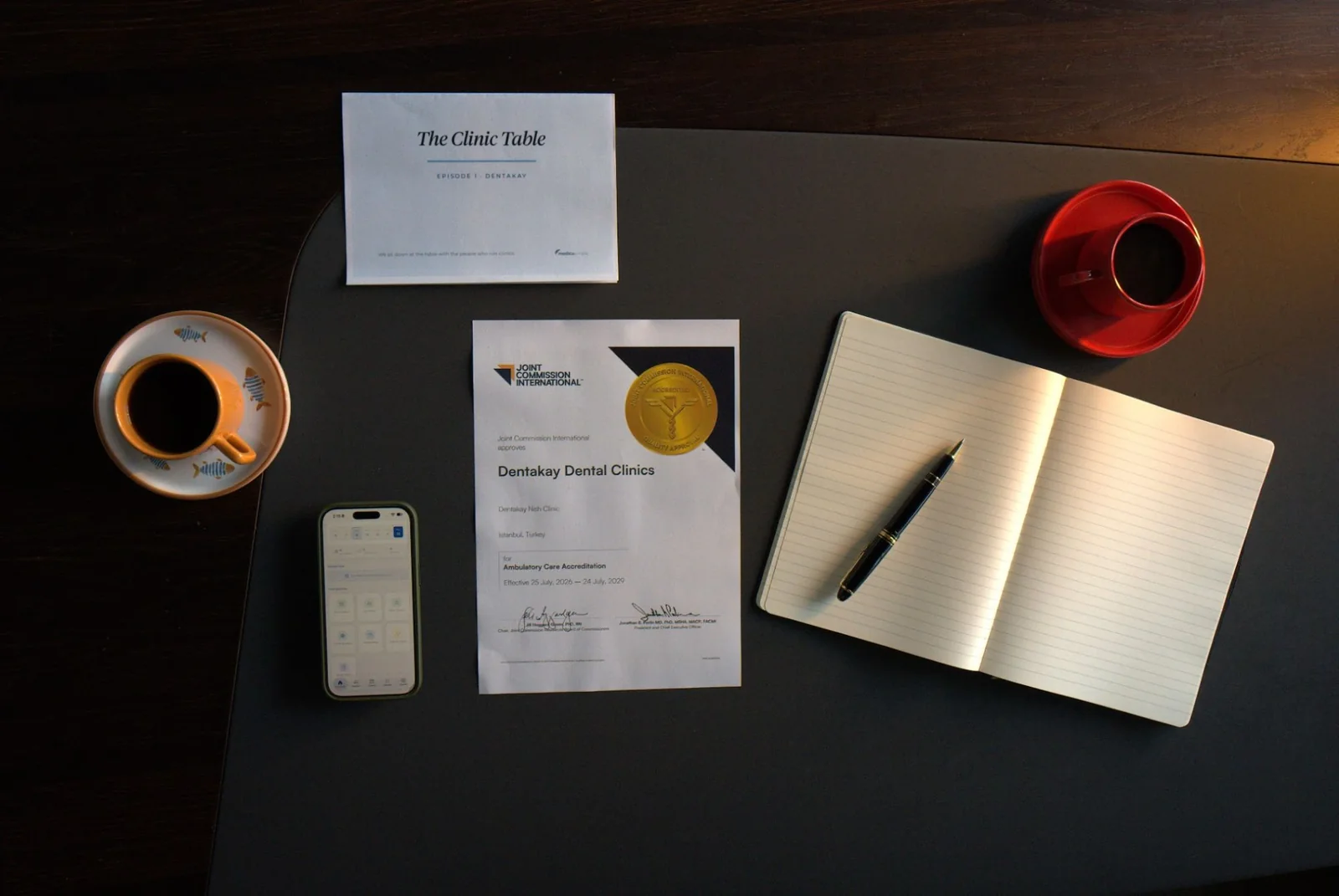
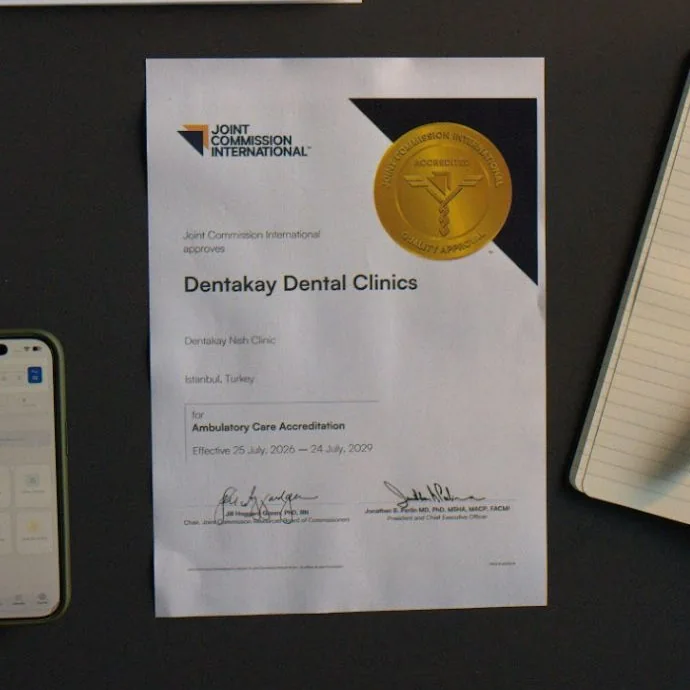
We sat down with them at Dentakay Nish Clinic, the accreditation certificate on the table between us.
On the table
Dentakay Nish Clinic's JCI certificate for Ambulatory Care, valid for three years from 25 July 2026.
01 · Why JCI?
Wherever we fell short, we wanted to fix it.
Tell us about yourselves first. What are your roles at Dentakay, and how did you divide up the JCI work?
Yesim Agacdan: I'm the Patient Relations and Quality Assurance Coordinator at Dentakay, and I led the JCI process. It took more than a year of very close work with all our clinics, our office team and with you. We made a lot of decisions along the way and changed a lot of things, and our software was one of them.
Baris A.: The process was led by Yesim, Dr Gulay Akay and Onur Akay, and our team had a real part in it. Honestly, we were involved in most of it. For many of the requirements Yesim brought to us, we were the bridge to the technology. Sometimes we rolled up our sleeves and did the work ourselves.
What does Dentakay look like today?
Baris A.: We're a dental group with 10 clinics, 8 of them in Türkiye, and we're opening in London very soon. Besides Istanbul, Ankara and Antalya, we have clinics in Mexico and Riyadh, and offices in Dubai, Egypt, Algeria and London as well as Türkiye. We run all 10 clinics at once with a team of 650.
Our leadership's dream is to have a clinic in every dental tourism destination. To get there, every supplier you work with has to be excellent too. We hold ourselves to a high standard at Dentakay, so we knew our software had to come from the best in the business. That's one of the reasons we chose Medicasimple.
Your quality standards were already high. Why go for JCI?
Yesim Agacdan: We already took infection control, patient safety and staff safety seriously, and our standards were high. But we wanted to prove it with an international accreditation and raise the bar further. Meeting every national regulation wasn't enough for us; we wanted to go further and earn JCI, which is known as one of the toughest healthcare inspections in the world. Wherever we fell short, we wanted to fix it.
And it paid off in another way: we saw our weak spots. We went back over our software, our follow-up and our traceability from scratch. It changed the way we think. Now, whenever we make a decision, we're already thinking a step ahead.
02 · The first two days: shock
The level of detail was incredible, and everything had to be traceable from start to finish. We were all in shock. Some of us wanted to give up, but others really believed we could do it.
Once the decision was made and you started preparing, was it bigger than you expected?
Yesim Agacdan: Before we started, our consultant gave us two full days of training, nine to six. When we saw the JCI standards, our first thought was, “What have we got ourselves into?” But we did it. I'd say the preparation was neither easy nor impossible. There were plenty of moments when we struggled, and plenty when things went smoothly because we pulled together as a team.
Old habits die hard. How did you get everyone at several clinics working to the same standard?
Yesim Agacdan: A lot of that fell to clinic management and our medical coordinators. Our dentists were already following every standard and keeping records. But JCI brought in a lot of new things. Even what we used to agree on verbally now had to be written down and traceable. Our medical directors were hugely supportive, and our clinic managers and some of our dentists were really keen. Others pushed back, because to them it felt like extra work.
Medicasimple made this much easier, because we could do everything digitally. A dentist can see a patient's form even after they've left the room. Otherwise we'd have had to keep everything on paper, and writing it all up would have been a job in itself. The mobile app, being able to create new forms and shape the system around us made life much easier. We handled everything, traceability included, with our own custom forms.
03 · The night of the inspection
You were there for us on our big day. Just having you there with us, even with nothing to do, meant so much to us.
After a year of work, inspection day finally came. How did it feel?
Baris A.: You're on edge the whole time, because anything can happen. In an exam you get a second chance. Here you don't. You either pass or you fail. I was really tense.
Yesim Agacdan: My hands and feet were ice cold and clammy. It felt like a panic attack.
Is there a moment from those days that has stayed with you?
Baris A.: Being responsible for technology, two things stood out for me. The first was my own team. We're one company, of course, but you always look out for your own people. What mattered was making Yesim's project a success. Having my team beside me that night, the next night and for ten days straight was a huge relief.
But there's something else I'll never forget. Emir Gokdemir and Can Karaca from Medicasimple were with us, and you came along one day too. On the last night we were working late. Everyone was stressed, and there was still a lot to pull together. None of it was Emir's job; he didn't even need to be there. He turned to me and said, “What do you need? Shall I put something together in Excel? Just tell me, I'm here.” I said, “Emir, take it easy.” He said, “Come on. If we were tired, we wouldn't have come. We're not that kind of company.” It still gives me goosebumps.
Sure, they send you invoices. They're the vendor, and you're the customer. But this went well beyond a normal business relationship: you never feel alone. At one in the morning, someone is telling you, “It's not our job, but who cares? Let's get it done together.” That lifted all of us.
Yesim Agacdan: There was nothing in the system that could go wrong; it just runs. Normally they wouldn't even have needed to be here. But that day was like a wedding for us. You were there for us, and just having you with us meant so much. We were moved, and very proud. We knew then that you'd be with us whatever happens.
04 · The only smart person at the table
It's like playing ping-pong, and the ball never drops. There's no winner. The rally just keeps going, and both sides play hard. The crowd enjoys it, and so do the players.
What were you looking for when you chose your software?
Yesim Agacdan: We'd been using software we weren't happy with, because we couldn't adapt it to our needs, and Dentakay's needs are different. We laid them all out in our first meeting, before we'd even applied for JCI. We said, “We're going to ask you for some very unusual things, and this could take you somewhere new.” We even asked for more than we needed, because we wanted to see whether you'd stick with us. When you said, “We'll do our best to build whatever you need,” that meant a lot to us. And you really delivered.
We talk to other hospitals and clinics going through the same process, and they ask us how we solved this. When we tell them, “We build the form in Medicasimple, track it here and pass it on there,” they're surprised, because for many of them this is exactly the part that's missing. Record keeping was the most important part, and we had it 100 per cent covered. The inspector didn't raise a single finding there, not even a recommendation.
What makes a good software partner for you?
Baris A.: I'm saying this with my engineer's hat on, not my marketing one. Choosing a software company takes a bit of luck. Good companies are out there, but finding one can come down to luck; you search and search and they never turn up. Second, if you sit down at a table and you, the customer, are the only smart person there, that relationship will never end well. When we brought Medicasimple in, I realised I wasn't the only smart person at the table. Some of their team are a lot sharper than me.
Working together is like a game of ping-pong where the ball never drops. Nobody wins; the rally just keeps going, both sides play hard, and the players enjoy it as much as the crowd. That's how I've always seen the way Medicasimple and Dentakay work together. And it goes both ways. It's part of Dentakay's culture: when we work with a vendor, we always look together at how we can help them grow too.
How has day-to-day work changed since Medicasimple?
Baris A.: I love automation. Not so we can make more money with fewer people, but because I want every job done in the most efficient way. Before Medicasimple, a lot of our work was manual and ran through endless WhatsApp groups. Now it's like setting your coffee machine for eight in the morning: at eight it starts brewing, and your coffee is ready. That's what it feels like. If you value your time, you recognise a good product straight away. We're always racing against the clock, so we're always looking for ways to be more efficient.
05 · Life after accreditation
More than half of our patients have started telling us they chose us because of our JCI accreditation.
What has accreditation done for Dentakay?
Yesim Agacdan: Accreditation changed a lot for us, almost without our noticing. Our whole team has completed its training, and everyone is aware of patient safety. Our traceability is getting close to 100 per cent. We now record even which dental equipment was used and every sterilisation cycle, and we can see and follow it all from the patient record in Medicasimple. It has changed the way both our dentists and our patients see things.
We also ran a patient survey. More than half of our patients said they chose us because of our JCI accreditation. That's a big step for us.
If you could give one piece of advice to a clinic preparing for JCI, what would it be?
Yesim Agacdan: Have software you can adapt to your needs. You'll face all kinds of requirements and questions, and you need to be able to change things within the system. There will be a lot you have to document and prove, so your software has to be able to handle that. It has to understand you.
What's next?
Yesim Agacdan: We've started preparing for TEMOS. It's an accreditation like JCI, but it comes from Germany and is designed specifically for dental clinics. JCI took us a year; we're aiming to get TEMOS within four or five months. After that come other accreditations and ISO standards. So this never really ends. We'll keep growing and keep improving.
Baris A.: JCI is the gold standard. If a clinic claims to do things better and more properly than anyone, then everything counts. You need two feet to walk; this takes something like twenty: your people, good clinic management software, a good CRM, a good consultant, the clinic itself and its physical environment. If one of them is missing, you lose your footing. We keep improving and never stand still. As we always say, our biggest competitor is ourselves.
The other side of the table
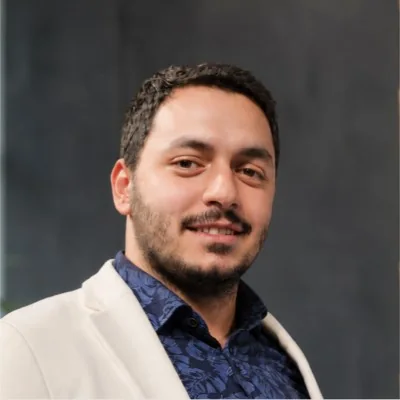
The first time we sat down with Dentakay, they told us, “We're going to ask you for some very unusual things,” and they meant it. Throughout the JCI preparation, every new requirement was a new question for us too, and we built the forms, the records and the traceability together. Being there on the last night of the inspection didn't feel like a duty. It felt like having a seat at that table.
The Clinic Table
We sit down at the table with the people who run clinics.